GOB Retail is located in Clawson, along the border between Oakland and Maccomb counties in the state of Michigan. A near northern suburb of Detroit. The store is in near
proximity to the cities of Royal Oak, Warren, Hazel Park, Madison Heights, Troy, Sterling Heights, Ferndale, Detroit and Berkley and reasonable drive from numerouns other communities,
including Southfield, Rochester Hills, Rochester, St. Clair Shores, Roseville, Auburn Hills, Bloomfield Township, Clinton Township, Shelby Township, Utica, East Pointe, Beverly
Hills, Birmingham,Pontiac, Oak Park and Waterford. The store is just 1 mile east off of I-75, which makes it easily accessible from further out via connections with I-696, I-96 and M59.
GOB Retail carries all the major brands and likely a bunch you have never heard of as well. Here are just a few:
Search for Board Games, Puzzles
Please Fill out criterias for games you're looking for below, then Click Search Button.
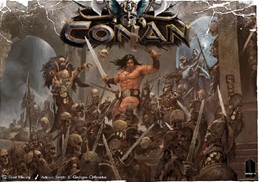
Description Conan, based on the Conan universe by Robert E. Howard, is a scenario-based semi-cooperative asymmetric miniatures board game. One player is the Overlord, playing the opposition forces, and the other players play Conan and his companions: Shevatas the thief, Hadrathus the Priest/Sorcerer, Belit the pirate queen, Valeria the warrior, etc. The game is based purely on Robert E. Howard's novels and short stories.
Each game is a scenario, played on a map. There are 4 maps included in the retail copy of the game, and each map can have several scenarios set on it. The game is fast, one hour approximately. It's possible to play several scenarios in a campaign, but you can also play each scenario individually. There are 9 scenarios in the base box.
At the beginning of a scenario, players choose their team (Conan and two or three other heroes). The Overlord gathers all the miniatures (picts, Necromancer, skeleton warriors, monsters, etc.), tokens, and cards from the chosen scenario. The game usually plays in a limited number of turns (ten, for instance). Each scenario can have very different objectives.
During their turn, the heroes can activate or rest. If they activate, they can spend "gems" from their energy pool to do all sorts of actions: move, fight (melee or distance), defend, pick a lock, reroll, etc. If they rest, they can move a lot of gems from their "spent" pool box to their "available" pool box. The Overlord plays differently. He uses a board with eight slidable tiles, plus his own Energy gems. Each tile corresponds to one unit (1 to 3 miniatures) on the game mat, and all of the miniature abilities are written on this tile (movement, armor, attack, special abilities). The tile position on the board corresponds to the numbers 1-8. The Overlord has a pool of energy gems and each time he activates one unit, he needs to spend a number of gems matching the tile placement.
In a typical scenario, the heroes need to accomplish something and the Overlord wins if the heroes fail to reach their objective — but in some scenarios, the Overlord has his own objectives and the Heroes win if they prevent him from accomplishing his goal.